
Modeling nerve cells can facilitate the formulation of hypotheses regarding their actual behavior and thus improve our understanding of their functioning. The first models of neural activity date back to the beginning of the 20th century, when L. Lapicque proposed a simple integrate-and-fire model of a neuron. A few decades later, Hodgkin and Huxley introduced a conductance-based model describing the initiation and propagation of action potentials in neurons. Since then, many other models have been proposed, both stochastic and deterministic, including a wide class of hybrid models. However, as there is no “universal model,” the question always is which model is able to reproduce biological phenomena of interest in a given situation. Therefore, it is important to distinguish between various neuron models and understand the dynamical mechanisms behind their properties.
Discrete and Hybrid Neuron Models
In her scientific research in the area of mathematical neuroscience, Dr. Justyna Signerska from Gdańsk University of Technology collaborates with other research centers and groups, including the University of Pittsburgh (USA), Brandeis University (USA), INRIA (France), and the University of Castilla-La Mancha (Spain). Together with her colleagues from the Division of Differential Equations and Applications of Mathematics—Prof. Piotr Bartłomiejczyk, Prof. Paweł Pilarczyk, and Prof. Grzegorz Graff (the head of the Division)—she develops rigorous mathematical and computational methods that are successfully applied to the investigation of hybrid and discrete neuron models. This includes obtaining new theoretical results, especially in the domains of low-dimensional dynamics and nonlinear data analysis, based on questions arising during the investigation of these models, and subsequently exploiting these findings to provide a rigorous description of the models’ behavior. The application-oriented part is devoted mainly to integrate-and-fire (IF or spiking) neuron models, map-based neuron models, and the analysis of time series such as EEG signals.
IF models are especially interesting objects of exploration since they belong to so-called hybrid systems: they combine continuous dynamical systems (given by a system of ODEs, called the “subthreshold system”), accounting for the excitable properties of nerve cells, with discrete events; namely, the membrane voltage resetting mechanism after a certain threshold is reached, which abstracts the mechanism of spike (action potential) emission. Over the last decade, hybrid systems have attracted growing attention due to their numerous potential applications.
The primary analytical tool is the so-called “adaptation map” (or firing map)—a mapping whose successive iterations allow for the reconstruction of the time series of consecutive resets, and thus the character of the spike trains generated by the cell (e.g., whether we are dealing with phasic or tonic spiking, or so-called “bursting,” where spikes are grouped into “clusters” of several action potentials occurring in immediate succession, followed by periods of “quiescence”). Hence, knowledge of the orbits of this map encodes many qualitative features of the model that are significant from a biological standpoint.
The results obtained by Dr. Signerska and her co-authors concern many well-known and widely used models in the mathematical neurobiology community, such as the Brette and Gerstner model (2005) or the Touboul and Brette model (2009, the so-called quartic model). For example, by applying the theory of unimodal interval maps (including the recent results covering cases beyond negative Schwarzian derivative), as well as elements of geometric singular perturbation theory, a mathematically intriguing phenomenon known as spike-adding was rigorously explained. Here, with an increase in the resting potential value (to which resetting occurs after reaching the “threshold”), a gradual increase in the number of spikes within individual bursts can be observed, preceded by periods of chaotic behavior—a phenomenon previously observed numerically, but never before strictly explained. Due to its biological importance and mathematical complexity, “bursting” has previously been the subject of outstanding results in other types of dynamical systems (e.g., Belousov-Zhabotinsky reactions) obtained by mathematicians such as Rinzel, Troy, and Levi, among others. In other works concerning this class of models, we proved that the hybrid system is able to generate so-called mixed-mode (bursting) oscillations (MM(B)Os), whose signatures can be “decoded” using symbolic dynamics describing a given orbit of the adaptation map. The innovative nature of these results is further underscored by the fact that mixed-mode oscillations had never before been observed in hybrid systems of this type. Meanwhile, MMOs occur in various types of cells and brain regions, contributing to the precision and stability of information processing by neurons.
The most recent works by the group at Gdańsk Tech represent a far-reaching extension of the results regarding hybrid (two- and higher-dimensional) nonlinear IF models, as they investigate non-autonomous systems where one-dimensional adaptation-type maps are incapable of capturing the complex dynamics. Thus, these systems pose a distinctly new challenge, especially under a rigorous analytical approach. In particular, a geometric characterization of dynamical structures (so-called dynamic threshold curves) related to post-inhibitory facilitation (PIF) or response precision in forced excitable systems was provided, along with an analytical description of slope detection. These phenomena have been observed in the auditory system, e.g. in the medial superior olive neuron. Many researchers believed that these behaviours were limited to a specific class of neuronal excitability (namely, type III neurons, according to Hodgkin’s electrophysiological classification of nerve cells), but our results demonstrate that they can be linked to a broader group of neurons.
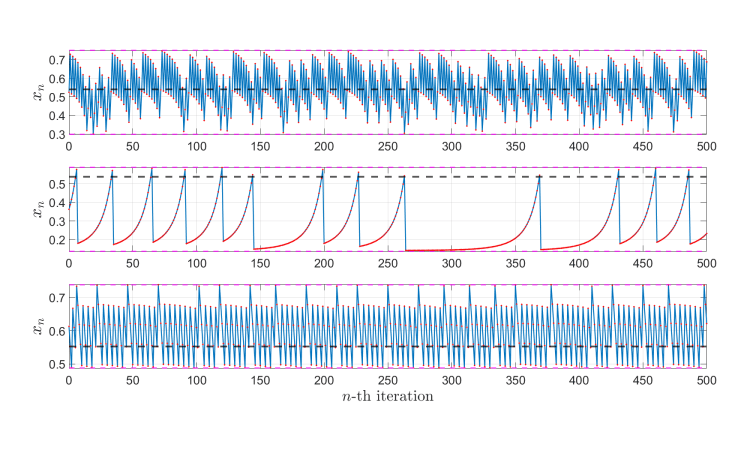
Another class of investigated systems consists of map-based neuron models. These are discrete models in which the evolution of the neuron membrane voltage and spike emission are captured by iterations of piecewise smooth (or piecewise continuous) maps. Although these models seem simpler when compared with hybrid or continuous neuron models and remain somewhat abstract from a biological viewpoint, they are often created as discretizations of continuous or hybrid models. Therefore, it is natural to compare the repertoire of behaviors displayed by these two types of models and the mechanisms generating them. However, due to the discrete nature of map-based neuron models, rigorous mathematical analysis can still be challenging. In particular, for a discrete neuron model introduced by D. Chialvo, we incorporated rigorous numerics (so-called computer-assisted proofs) and obtained a comprehensive picture of its global dynamics (in a two-parameter space). Additionally, we introduced a new algorithm for analyzing return times within invariant sets. Based on this analysis, along with information on the size of the chain-recurrent set, we developed a new method allowing for the determination of parameter subsets where chaotic dynamics may arise, opening a wide scope for applications in the study of other multi-parameter systems with a complex bifurcation structure. Our other works address the Courbage–Nekorkin–Vdovin model (CNV for short), which is important due to its diverse applications in clinical and biological modeling. By showing that in a large subset of the multidimensional parameter space the return map of the potential variable is an expanding Lorenz-like map, we analyzed both the chaotic and periodic behaviors of the system, explaining the complexity of the spike trains generated by the neuron through the underlying geometrical mechanisms. To achieve this goal, we integrated and extended several results from the theory of Lorenz maps. The title figure shows three different patterns of neuron voltage time series in the CNV model reproducing, consecutively, bursting, tonic spiking and oscillatory spiking (from the top to the bottom).
Finally, in collaboration with the Dioscuri Centre in Topological Data Analysis (located at the University of Warsaw and headed by Prof. Paweł Dłotko), we have also adapted topological data analysis methods (in particular, Euler Characteristic Curves and Profiles) to systems defined solely by (finite) time series or samples of experimental data, which also allow for better and “almost automatic” detection of qualitative changes in dynamical systems. The methods have been tested on benchmark systems, including sampled classical neuron models such as the FitzHugh–Nagumo model, and currently we are transferring these methods to high-dimensional datasets such as single-cell transcriptomic data, which is part of a research project conducted by one of our PhD students, Marta Marszewska. Dr. Signerska also supervises MSc students in another project where TDA tools (persistent homology in this case) are successfully applied to neuronal data analysis, namely the classification of healthy children and children with autism spectrum disorder based on EEG signals.
Featured publications:
[1] J.E. Rubin, J. Signerska-Rynkowska, J.D. Touboul. Type III Responses to Transient Inputs in Hybrid Nonlinear Neuron Models. SIAM Journal on Applied Dynamical Systems, 2021, 20(2): 953-980; doi 10.1137/20M1354970
[2] P. Pilarczyk, J. Signerska-Rynkowska, G. Graff. Topological-numerical analysis of a two-dimensional discrete neuron model. Chaos, 2023, 33(4): 043110; doi 10.1063/5.0129859
[3] P. Bartłomiejczyk, F. Llovera Trujillo, J. Signerska-Rynkowska. Analysis of dynamics of a map-based neuron model via Lorenz maps. Chaos, 2024, 34(4): 043110; doi 10.1063/5.0188464