
By Karel Nana Kemajou (Ph.D. Student, University of Wuppertal)
Supervised by PD Dr. Long Teng and Prof. Dr. Cornelis W. Oosterlee
👋 Introduction & Motivation
My name is Karel Nana Kemajou, and I am a Ph.D. student in the Applied and Computational Mathematics group at the University of Wuppertal, Germany. My research focuses on optimal battery storage trading in intraday electricity markets.
Because wind and solar output varies significantly with changing weather patterns, modern power grids rely heavily on large-scale battery storage systems. These batteries buy electricity when generation is abundant and inexpensive, and sell it when generation is scarce and prices peak. This presents a fundamental operational question for battery owners: When should the battery buy electricity, and when should it sell?
Because electricity prices move randomly, this translates into a complex stochastic optimal control problem. The overarching goal for a battery owner is to maximize trading revenue while strictly respecting operational constraints, such as power limits, stored energy capacity, round-trip efficiency, and daily cycle limits. My current research compares two established methodologies for this problem and analyzes under what specific market conditions one method outperforms the other.

⚖️ Comparing Two Approaches: Rolling Intrinsic vs. Least Squares Monte Carlo
To tackle this stochastic control problem, different modeling paradigms approach decision-making from distinct angles:
- 🔄 Rolling Intrinsic (RI): This approach treats the current electricity prices for all remaining delivery periods as deterministic certainties. It solves the resulting fixed-price dispatch problem and continuously re-optimizes as new price quotes arrive.
- 📊 Least Squares Monte Carlo (LSMC): Instead of assuming certainty, LSMC simulates numerous potential price paths. Using regression across these paths moving backwards in time, it estimates the expected value of future trading options at each stage, using these guidelines to steer trading decisions forward.
This research is joint work with my supervisors, Long Teng and Cornelis W. Oosterlee. We evaluate the performance of both methods within a controlled synthetic framework where prices are generated via a multivariate Ornstein-Uhlenbeck process combined with a nonlinear polynomial transformation. This setup allows us to isolate and vary individual features of the price dynamics to observe their distinct impacts on both strategies.
📉 Capturing Market Dynamics: The Samuelson Effect
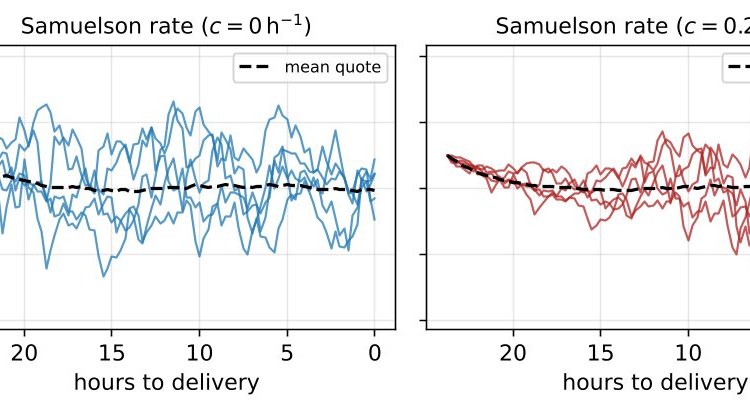
In our simulations, we evaluate both methods over a 100-day trading horizon while varying key market parameters, including the mean-reversion speed and the Samuelson effect—a well-known market phenomenon where electricity prices become increasingly volatile as the actual delivery time approaches.

Our parameter-plane experiments reveal a clear split:
- In one distinct region of market conditions, the Rolling Intrinsic (RI) approach earns higher revenue.
- In another region, the Least Squares Monte Carlo (LSMC) method takes the lead.
🎯 Outlook and Next Steps
Ultimately, our experiments show that there is no single universal answer to when a battery should buy or sell. Understanding how electricity price dynamics behave is just as critical as choosing the optimization method itself.
Our next objective is to examine whether these comparative findings hold true in real-world electricity markets, where price dynamics are significantly more complex and harder to predict. Stay tuned for further updates from our research group at the University of Wuppertal!
📚 References
- X. Luo, J. Wang, M. Dooner, and J. Clarke, “Overview of current development in electrical energy storage technologies and the application potential in power system operation,” Applied Energy 137 (2015) 511–536.
- D. P. Bertsekas and S. E. Shreve, Stochastic Optimal Control: The Discrete-Time Case, Athena Scientific, Belmont, MA (1996).
- D. Oeltz and T. Pfingsten, “Rolling intrinsic for battery valuation in day-ahead and intraday markets,” arXiv:2510.01956 (2025).
- F. A. Longstaff and E. S. Schwartz, “Valuing American options by simulation: a simple least-squares approach,” The Review of Financial Studies 14 (2001) 113–147.
- B. C. Boonstra and C. W. Oosterlee, “Valuation of electricity storage contracts using the COS method,” Applied Mathematics and Computation 410 (2021) 126416.
- T. Deschatre and X. Warin, “A common shock model for multidimensional electricity intraday price modelling with application to battery valuation,” Quantitative Finance 24 (2024) 1157–1176.